Food and Diet News and Weight Loss Plans
Dieting is the practice of ingesting food in a regulated fashion to achieve or maintain a controlled weight. In most cases the goal is weight loss in those who are overweight or obese, but some athletes aspire to gain weight (usually in the form of muscle) and diets can also be used to maintain a stable body weight.
Diets to promote weight loss are generally divided into four categories: low-fat, low-carbohydrate, low-calorie, and very low calorie.[1] A meta-analysis of six randomized controlled trials found no difference between the main diet types (low calorie, low carbohydrate, and low fat), with a 2–4 kilogram weight loss in all studies.[1] At two years all diet types cause equal weight loss irrespective of the macronutrients emphasized.[2]
There are several kinds of diets:
Receiving adequate nutrition through a well-balanced diet is crucial during childhood and adolescence. Some diets can deprive the body of necessary nutrients, for instance lipids. In addition, there are some indications that the harmful effects of starvation or extreme dieting during adolescence exceed the expected benefits, sometimes even leading to increased weight gains.[4]
Research shows that putting children on starvation or extreme diets can be harmful. The brain is unable to learn how to correlate taste with nutritional value, which is why such children may consistently overeat later in their life despite adequate nutritional intake. [5]
As endotherms, humans expend energy to maintain their blood temperature at body temperature, which is approximately 37 °C (98.6 °F). This is accomplished by metabolism and blood circulation, by shivering to stay warm, and by sweating to stay cool.[6]
In addition to thermoregulation, humans expend energy keeping the vital organs (especially the lungs, heart and brain) functioning. Except when sleeping, our skeletal muscles are working, typically to maintain upright posture. The average work done just to stay alive is the basal metabolic rate.
Physical exercise is an important complement to dieting in securing weight loss. Aerobic exercise is also an important part of maintaining normal good health, especially the muscular strength of the heart.
Though the energy for muscle activity is primarily derived from the glycogen stored in the body, continued activity results in an increased use of the fatty acids as well. After the available glycogen stores are exhausted, fatty acids alone are used [7]. It is often recommended that muscle activity be maintained for 20 minutes or more for increased usage of fatty acids.
The energy burnt during physical exercise has only a limited effect on weight loss, since an hour of aerobic exercise for a man in reasonable physical shape would burn about 2 megajoules (500 kilocalories), which is equivalent to only 60 grams (2 oz) of fat.
Both aerobic and anaerobic exercise would increase the basal metabolic rate (BMR) for some time after exercising. This leads to an additional caloric loss.
Weight loss typically involves the loss of fat, water and muscle. Overweight people, or people suffering from obesity, typically aim to reduce the percentage of body fat. Additionally, as muscle tissue is denser than fat, fat loss results in increased loss of body volume compared with muscle loss. Reducing even 10% body fat can therefore have a dramatic effect on a person’s body shape. To determine the proportion of weight loss that is due to decreased fat tissue, various methods of measuring body fat percentage have been developed.
Muscle loss during weight loss can be restricted by regularly lifting weights (or doing push-ups and other strength-oriented calisthenics) and by maintaining sufficient protein intake. Those on low-carbohydrate diets, and those doing particularly strenuous exercise, may wish to increase their protein intake. According to the National Academy of Sciences, the Dietary Reference Intake for protein is “0.8 grams per kilogram of body weight for adults.”
Excessive protein intake, may cause liver and kidney problems and may be a risk factor for heart disease.[8]. There is no conclusive evidence that moderately high protein diets in healthy individuals are dangerous, it has only been shown that these diets are dangerous in individuals who already have kidney and liver problems.
The energy intake from food is limited by the efficiency of digestion and the efficiency of utilization. The efficiency of digestion is largely dependent on the type of food being eaten, while efficiency of utilization is affected by individual factors, including body weight and hormones.
The effects of chewing, especially in elderly people, have been shown to affect the intake of micronutrients. However, there was no significant effect on the intake of macronutrients, such as sugars, fats, and proteins[9].
Food provides nutrients from six broad classes: proteins, fats, carbohydrates, vitamins, dietary minerals, and water. Carbohydrates are metabolized to provide energy. Proteins provide amino acids, which are required for cell construction, especially for the construction of muscle cells. Essential fatty acids are required for brain and cell membrane construction. Vitamins and trace minerals help maintain proper electrolyte balance and are required for many metabolic processes. Dietary fiber is another food component which influences health even though it is not actually absorbed into the body.
Any diet that fails to meet minimum nutritional requirements can threaten general health (and physical fitness in particular). If a person is not well enough to be active, weight loss and good quality of life will be unlikely.
The National Academy of Sciences and the World Health Organization publish guidelines for dietary intakes of all known essential nutrients.
Sometimes dieters will ingest excessive amounts of vitamin and mineral supplements. While this is usually harmless, some nutrients are dangerous. Men (and women who don’t menstruate) need to be wary of iron poisoning. Retinol (oil-soluble vitamin A) is toxic in large doses. As a general rule, most people can get the nutrition they need from foods. In any event, a multivitamin taken once a day will suffice for the majority of the population.
Weight-loss diets which manipulate the proportion of macronutrients (low-fat, low-carbohydrate, etc.) have not been found to be more effective than diets which maintain a typical mix of foods with smaller portions and perhaps some substitutions (e.g. low-fat milk, or less salad dressing).[10] Extreme diets may, in some cases, lead to malnutrition.
All body processes require energy to run properly. When the body is expending more energy than it is taking in (e.g. when exercising), the body’s cells rely on internally stored energy sources, like complex carbohydrates and fats, for energy. The first source the body turns to is glycogen (by glycogenolysis). Glycogen is a complex carbohydrate, where 65% of it is stored in skeletal muscles and the rest in the liver (totaling about 2000 kcal in the whole body). It is created from the excess of ingested macronutrients, mainly carbohydrates. When those sources are nearly depleted, the body begins lipolysis, the mobilization and catabolism of fat stores for energy. In this process, fats, obtained from adipose tissue, or fat cells, are broken down into glycerol and fatty acids, which can be used to make energy. The primary by-products of metabolism are carbon dioxide and water; carbon dioxide is expelled through the respiratory system.
Fats are also secreted by the sebaceous glands (in the skin).
Diets affect the “energy in” component of the energy balance by limiting or altering the distribution of foods. Techniques that affect the appetite can limit energy intake by affecting the desire to overeat.
Cognitive Behavior Therapy has been effective in producing long term weight loss [11]. Judith S. Beck has been one of the most prominent practitioners and writers to bring this method to a popular audience.
Consumption of low-energy, fiber-rich foods, such as non-starchy vegetables, is effective in obtaining satiation (the feeling of “fullness”). Exercise is also useful in controlling appetite as is drinking water and sleeping.
The use of drugs to control appetite is also common. Stimulants are often taken as a means to suppress hunger in people who are dieting. Ephedrine (through facilitating the release of adrenaline and noradrenaline) stimulates the alpha(1)-adrenoreceptor subtype, which is known to act as an anorectic. L-Phenylalanine, an amino acid found in whey protein powders also has the ability to suppress appetite by increasing the hormone cholecystokinin (CCK) which sends a satiety signal to the brain.
There exist both profit-oriented and non-profit weight loss organizations who assist people in their weight loss efforts. An example of the former is Weight Watchers; examples of the latter include Overeaters Anonymous, as well as a multitude of non-branded support groups run by local churches, hospitals, and like-minded individuals.
These organizations’ customs and practices differ widely. Some groups are modelled on twelve-step programs, while others are quite informal. Some groups advocate certain prepared foods or special menus, while others train dieters to make healthy choices from restaurant menus and while grocery-shopping and cooking.
Most groups leverage the power of group meetings to provide counseling, emotional support, problem-solving, and useful information.
A July 2008 study, published in the American Journal of Preventive Medicine, showed dieters who keep a daily food diary (or diet journal) of what they eat lose twice as much weight as those who do not. The researchers concluded, “It seems that the simple act of writing down what you eat encourages people to consume fewer calories.”[12] Diet journaling software and websites have become popular to help people track calorie consumption, calorie burning, weight loss goals, and nutritional balance.
Obesity is the second leading cause of preventable death in the U.S. [1]
Want to slim down fast for that beach vacation or high school reunion? While there are many things you can do to shed pounds, losing weight too quickly, like any sudden change to your body, can be dangerous. While fad diets, diet pills, and fasting may indeed induce rapid weight loss, these methods can cause you to lose muscle and may also injure your heart and other organs fairly quickly. The best solution? Don’t go for an overnight miracle. Instead, follow these steps to lose fat rapidly, healthily, and sustainably.
So what is your New Year Resolution? To lose weight and get the shape you desire fast and keep to your plans to achieve your desired weight goal
successfully lose weight takes time, and you need to take the time to do it or you will become frustrated. Be patient.
Most of us find ourselves facing each New Year with the same 10 pound resolution or whatever our personal number is. Fad diets have failed us, many have tried and lost weight using the larger weight loss programs, such as Weight Watchers and Jenny Craig or Nutri Systems. I have friends who are in FA, (Food Addicts Anonymous). On thing has remained the same in my life, most of the people I know gain at least part of the weight back.
Right now Oprah Winfrey just announced that she has gained much of her weight back.
After years of dieting and having her own people, like her chef Rosie, ( I have this book, and the recipes are very good!)
Even Oprah, with all that money and resources has gained back part of her weight and struggles to keep it off. She even has her own trainer!
The problem or I should say challenge with losing weight and keeping it off, is you literally have to change what you do and that involves changing habits. One of the hardest things for us humans to do.
So lets start with just some basic ideas to help change a few of your habits in the New Year.
You can start your treadmill, or exercise bike, or just walking around your neighborhood.
These are easy and frugal ways to start changing habits and patterns you may have developed over the years.
A few ideas to jump start your New Year weight loss program are things like:
You can nurture your friendship and start your journey to fitness at the same time. Just remember, we did not get this extra weight overnight, and we will not lose it overnight either.
A few more behavioral tips to help you are:
1. Put down your fork between bites.
2. Drink a glass of water before you start eating.
(did you know that many times when you feel hungry, your body is actually telling you that it needs
some water?)
3. Eat half your meal, stop, and save the rest for later. ( I do this with large meals and I am amazed how mentally it helps me, and also saves me calories, since I usually only eat the 2nd half later rather then an entire new meal)
4. Eat slower, let your food "hit bottom"
5. Do NOT eat in front of the TV or computer. (this is really hard for me!)
Make your meal a time of peace and quiet and focus on your food. Many of us eat without thought.
We eat to feel better and distract ourself from our feelings.
6. Keep a food journal, ( another thing I always start but never stick too!)
Studies have proven people who wrote everything down, ate less and had better success at changing
their eating habits. I have been using fitday for years , it is free and I can look back at the last 7 New Years and see the same 10 pound resolution I have made all this time in my online journal there.
Hang in there, stay positive and remember, you only have one life and you can change and make it what it you want to be. Just start small, and keep building up positive actions, one small thing at a time. Try to make just a few changes, and pat yourself on the back as you make them.
Be proud of yourself for each step you make towards change. Change is hard and a lifetime of habits takes time to undo. It seems women especially are so hard on themselves. Please start your day off with some positive affirmations about yourself and what you want out of the day. This can change your whole day. Take that time for yourself, you need it. Best of luck and Happy New Year!
I just finished reading Valerie Berinelli’s book “Losing it and gaining my life back one pound at a time.”
I enjoyed it. She writes in a friendly conversational manner. The one thing that really stuck out for me
was when she talked about her Jenny Craig Diet plan and how she had to walk 10,000 steps a day and use a Pedometer. I have been meaning to get one those and track how many steps on the treadmill I am walking. I just bought one from Amazon that has over 1800 reviews and 4 stars! That has to be good.
In a quest to burn the extra calories, walking seems to be the easiest way. Experts have revealed that walking 10,000 steps a day can help you drop those unwanted pounds faster than just about any other method of weight loss. Not only that walking will also help you keep the weight off for a longer period of time as it builds your muscles while keeping your heart at a fat-burning rate.
Quick facts about walking 10,000 steps
Use a Pedometer: For counting the number of steps that you have covered the best approach is to have a pedometer which can help you easily keep track of the distance you have covered throughout your day as well as the number of steps that you have taken. (A pedometer is a small box-shaped calculator that you can clip to your belt or pants pocket in the same way you would wear a beeper.) While purchasing for a pedometer, doubly ensure that you select a model that has both distance and well as individual step readings. This will be helpful for you to learn how many steps go into one mile.
You can increase steps to your count choosing the stairs over the elevator or walking to your colleague's desk rather than sending an email.
Calculate the Time it takes: Using either you pedometer or a counting method, calculate the approximate time it takes for you to traverse a specific distance, such as a mile. Calculate this number several times on several different days and average the figures together. You will then be able to determine approximately how long it will take you to walk a portion of your steps if you choose to spend a set amount of time walking them off. For example, if you know that you can walk all 10,000 steps in an hour, then you can elect to dedicate an hour everyday to walking your steps. But if spending 1 hr is not sufficient then break then you can add up increments of ten minutes at a time until you reach your goal.
To break the monotony select two-three routes to follow, and do the measurement a Route Measure a route based on the time and distances it takes you to walk your 10,000 steps. Go for a long route for days when you have a surfeit of energy, a short route for days when you are tired, and a mid-length route for days when you are energized but busy.
Jakob Culver is founder of the website – http://thefitnesslife.com and has a solid background in weight loss and fitness.
To find out more information about this topic or health and fitness visit =>http://thefitnesslife.com
Article Source: http://EzineArticles.com/?expert=Jakob_Culver
This is such a cool idea. Featured in the NYT health section.
I Put In 5 Miles at the Office
Chris Machian for The New York Times
Walking 9 to 5 Zandra Hooks, right, and Kirk Hurley can answer phones and do computer work (not to mention burn calories) on their Walkstations at Mutual of Omaha.
By MANDY KATZ
Published: September 16, 2008
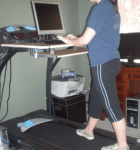
TERRI KRIVOSHA, a partner at a Minneapolis law firm, logs three miles each workday on a treadmill without leaving her desk. She finds it easier to exercise while she types than to attend aerobics classes at the crack of dawn.
Andrew Shurtleff for The New York Times
Dr. Joe Stirt on his home-office treadmill.
Brad Rhoads, a computer programmer and missionary in Princeton, Ill., faces a computer monitor on a file cabinet and gets in about five miles a day on a treadmill while working in his home office.
“After a while, your legs do get kind of tired,” said Mr. Rhoads, 40, who started exercising in March, when doctors advised him to lose weight after open-heart surgery.
Ms. Krivosha and Mr. Rhoads are part of a small but growing group of desk jockeys who were inspired by Dr. James Levine, an endocrinologist at the Mayo Clinic. In 2005, Dr. Levine led a study showing that lean people burn about 350 more calories a day than those who are overweight, by doing ordinary things like fidgeting, pacing or walking to the copier.
To incorporate extra movement into the routines of sedentary workers (himself included), Dr. Levine constructed a treadmill desk by sliding a bedside hospital tray over a $400 treadmill.
Without breaking a sweat, the so-called work-walker can burn an estimated 100 to 130 calories an hour at speeds slower than two miles an hour, Mayo research shows.
Enthusiasts began following Dr. Levine’s example, constructing treadmill desks that range from sleekly robotic set-ups to rickety mash-ups that could be Wall-E’s long-lost kin. But the recent introduction of an all-in-one treadmill desk from Details may inch work-walking into the mainstream, as dozens of businesses invest in the hardware to let their employees walk (and, ideally, lose a little weight) at work.
Since last November, about 335 Walkstations, have been sold nationwide to companies including Humana, Mutual of Omaha, GlaxoSmithKline and Best Buy.
The Walkstation, which Dr. Levine helped develop, costs about $4,000 and comes in 36 laminate finishes with an ergonomically curved desktop. Its quiet motor is designed for slow speeds, said David Kagan, director of marketing communications at Details, a division of Steelcase.
STILL, to most, work-walking is “a freaky thing to do,” said Joe Stirt, 60, an anesthesiologist in Charlottesville, Va., who works and blogs in his off hours while walking up to six hours a day in his home office.
Mr. Stirt’s site, www.bookofjoe.com/2007/10/treadmill-works.html, is one of some dozen work-walking blogs, including www.treadmill-desk.com and treadmill-workstation.com.
“I know lots of people who are using them,” Dr. Stirt said of the treadmill desks. “But there are probably a hundred times more who we don’t read about on the Internet.”
There is even a burgeoning social network (officewalkers.ning.com), with around 30 members, that Mr. Rhoads started in March.
To the uninitiated, work-walking sounds like a recipe for distraction. But devotees say the treadmill desks increase not only their activity but also their concentration.
“I thought it was ridiculous until I tried it,” said Ms. Krivosha, 49, a partner in the law firm of Maslon Edelman Borman & Brand.
Ms. Krivosha said it is tempting to become distracted during conference calls, but when she is exercising, she listens more intently.
“Walking just takes care of the A.D.D. part,” she said.
Still, work-walking can require crafty maneuvering. When colleagues drop in on Bruce Langer, another work-walker, he pivots, then keeps striding backward while facing them.
“It’s more polite and, from a workout standpoint, it works different muscles,” said Mr. Langer, a vice president of Tealwood Asset Management in Minneapolis.
In 2005, Salo, a professional placement firm in Minneapolis, contacted Dr. Levine after fashioning its first treadmill unit. (Employees called the cobbled-together unit “the Frankendesk.”) By 2007, Salo had become a test site for early Walkstation models and now has 16.
At Mutual of Omaha’s 150-person call center in Omaha, four Walkstations have been in use since July as part of a small company study to figure out whether work-walking could maintain productivity while reducing employees’ cholesterol, weight and blood-sugar levels. Sixteen subjects of different ages, weights and fitness levels work-walk two hours a day, said Peggy Rivedal, the manager of employee health services. A similarly diverse control group works the old-fashioned way.
After leaving the military two years ago, Kirk Hurley, 40, a customer service representative at Mutual of Omaha, gained 75 pounds. In two months of work-walking two hours a day, he has lost 16 pounds.
“You don’t really feel the physical strain on your body because your mind’s occupied with your work,” he said.
Treadmill desks will not likely replace the sit-down kind any time soon. In corporate settings, they are usually in open areas where employees can just jump on. At a few firms, including Salo, they have replaced conference tables.
SOME business colleagues arrive at meetings with walking shoes in hand, said Amy Langer, a Salo founder (and Mr. Langer’s wife).
But not every employee has the enthusiasm to keep work-walking day after day. Take the trial Walkstation at Humana, a health insurer in Louisville, Ky.
After a year on site, the treadmill is in use about 60 percent of the workday, mostly for conference calls, said Grant Harrison, the vice president of consumer innovation. Many workers, he said, may “try it out, but they don’t make it a part of their daily life.”
Nor does everyone have the coordination to walk and work, said Andrew Wood, the director of ergonomics and corporate services for Muve, a weight-management consultancy affiliated with the Mayo Clinic.
“If you can’t walk and chew gum at the same time, this may not be the workstation for you,” Mr. Wood said. But it should be a piece of cake for most people, he added.
James O. Hill, an obesity researcher and the director of the University of Colorado’s Center for Human Nutrition in Denver, shares this opinion: “There are not very many people who can’t walk,” he said. “You should have a doctor’s note to not walk.”
Will work-walking free you from the gym forever? Not if you’re seeking serious weight loss or peak cardio-respiratory fitness. “Walking on the treadmill could be enough to prevent weight gain, but it’s not going to melt the pounds off,” Dr. Hill said.
Still, something is better than nothing, say workwalkers like Mr. Rhoads.
“At least a little bit of exercise will just be part of my day and part of my working,” he said. “The one thing I always do is work.”
Correction: September 25, 2008
An article last Thursday about desks that include treadmills stated that Dr. James Levine, an endocrinologist at the Mayo Clinic, invented the first known treadmill desk. After the article was published, Seth Roberts, an emeritus professor of psychology at the University of California, Berkeley, pointed out that he had created such a desk in 1996, eight years before Dr. Levine.
Celebrity weight loss secrets: Posh’s favorite diet book,
Victoria Beckham shunning “moron” food
Not that Victoria “Posh Spice” Beckham needs to lose any weight, but she’s recently been spotted with the book Skinny Bitch, a guide to vegan eating with a sassy, Hollywood attitude. One critic says the book dispenses pretty common weight-loss advice: stop eating junk food, sugar, sweeteners, caffeine, dairy, refined carbs and alcohol. The book is apparently militantly anti-meat, calling people who try to lose weight while eating meat morons and referring to the Atkins Diet as the rotting meat diet. It’s more an advertisement for vegetarianism than it is a diet book. There’s a joke in there somewhere about the authors being bitches because they aren’t eating junk food, sugar, dairy and alcohol, I’m sure…